[Blog] How FPGAs Power Real-Time UAV Performance at the Edge
Posted 11/19/2025 by Lattice Semiconductor
Across industries and use cases, computing capacity is shifting away from centralized servers and towards the edge. Whether in the form of autonomous vehicles, smart sensors, or other technological solutions, today's intelligent applications demand faster decision-making and increased autonomy.
This shift is especially prevalent in the Industrial, defense, and aerospace industries. The unmanned aerial vehicles (UAVs) and drones used in defense applications rely heavily on edge intelligence to safely perform complex tasks including real-time threat object detection and autonomous navigation, in contested environments without relying on centralized command and control.
In a recent webinar, Lattice experts discussed the autonomous computing challenges facing the these industries, the role that Field Programmable Gate Arrays (FPGAs) play in enabling low latency sensor fusion, multi-stream processing, deterministic operation, and the specific design strategies that make supporting these devices possible. Read on for a high-level summary.
The Challenges Inhibiting UAV Operations
Modern UAVs face three major operational challenges:
- Sensor complexity
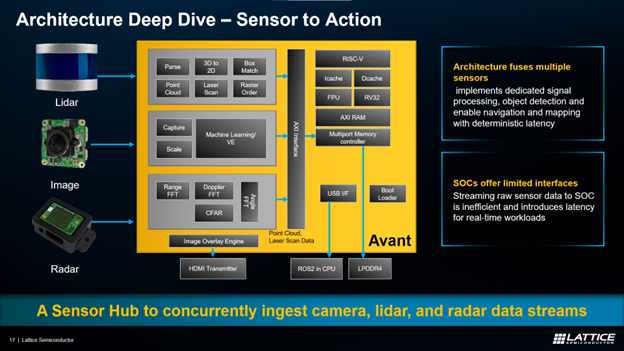
UAVs rely on a diverse array of sensors, including radar, lidar, cameras, and more. Each of these sensors is likely to leverage unique data formats and interface protocols, all of which need to be input into a coherent, flexible, and high-bandwidth processing pipeline while maintaining the security of data. This kind of integrated computing capacity is not always readily available at the edge, especially when processors are already tasked with other mission-critical responsibilities.
- Space and power constraints
Given their limited power availability and space constraints, UAV platforms demand lightweight and compact components that consume the minimum amount of power possible. Many traditional central processing units (CPUs) and graphics processing units (GPUs) lack the required sensor native interfaces and fall short in meeting the stringent Size, Weight, Power, and Cost (SWaP-C) requirements of these systems.
- Inadequate processing capacity
In mission-critical scenarios, latency can be the difference between success and failure. To enable key operating functions like autonomous navigation and adaptive targeting without succumbing to the pitfalls of latency, UAVs need real-time, high-quality data processing and streaming capabilities. This requires a significant amount of on-device compute capacity, which is not often accessible.
The Power of FPGA-Enabled UAVs
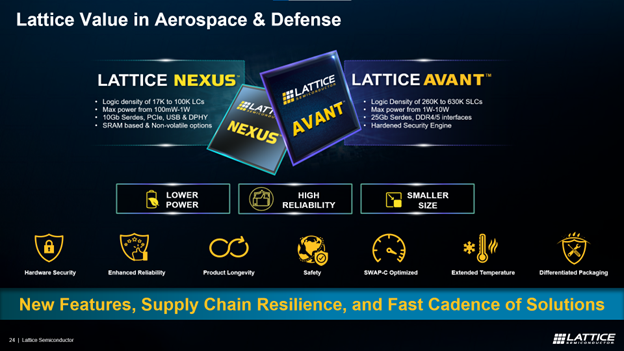
To meet the growing demands of modern UAV operations, Industrial, aerospace, and defense developers need hardware components that deliver advanced edge processing without compromising power efficiency or size constraints. Lattice FPGAs, including Lattice Nexus™ and Lattice Avant™ platform based devices, are purpose-built to operate in harsh conditions. By offering low power and small form factor designs, these FPGAs can enable longer mission durations, simplified thermal management, and seamless integration into compact UAV architectures while offering the most efficient edge compute solutions and architectures.
Beyond efficiency, FPGAs offer the critical advantage of parallel processing. They can execute multiple processing tasks simultaneously, ensuring the real-time and deterministic responsiveness that’s essential for autonomous flight control, object detection, and other mission-critical operations. Lattice FPGAs can act as intelligent companion chip bridges between sensors and compute platforms like the Nvidia Holoscan Sensor Bridge solution. Leveraged as a companion chip, the FPGA can offload tasks like interfacing, preprocessing, packetizing, and data streaming at the far edge, freeing up the primary chips for other critical processing tasks.
Lattice FPGAs further enhance UAV capabilities by enabling:
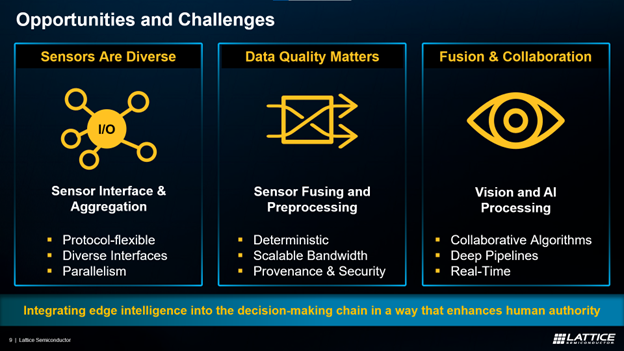
- Sensor fusion and edge AI. By fusing radar, lidar, and camera data into a unified processing system, FPGAs help to support accurate mapping, navigation, and autonomous object recognition. Their low latency processing ensures responsive decision making, even in difficult or fast-changing environments.
- Motor control and real-time responsiveness. With real-time performance and motion control IP, Lattice FPGAs can deliver up to 100X faster control than traditional CPUs. This precision helps to improve flight stability, extend range, and enhance energy efficiency in multi-motor UAV designs.
- Secure and resilient operation. Features like radiation tolerance, built-in secure boot, and authenticated firmware help enable safe and reliable UAV operation, even in harsh or contested environments. This is critical for devices whose operation is often highly sensitive and precise.
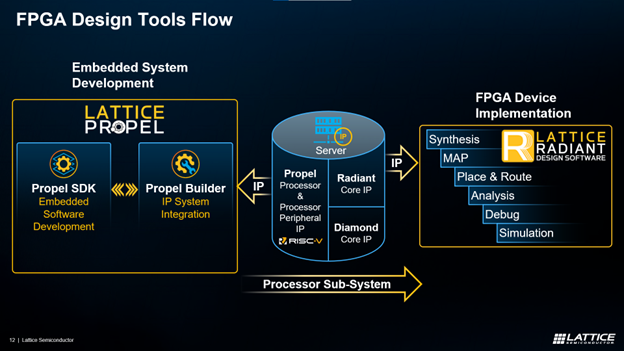
When the dynamic power of these chips is paired with the strength of streamlined and proven design tools like Lattice Propel™ and Lattice Radiant™, developers can easily incorporate FPGAs as critical components of their UAV builds.
Supporting Evolving UAV Models
As UAVs evolve to meet the demands of modern Industrial, aerospace, and defense operations, access to intelligent, efficient, and secure edge processing will be crucial. Lattice’s FPGA platforms are designed to meet these needs, offering low power, high performance, and flexible integration even in compact environments.
To learn more about supporting the evolving edge demands of UAV builds, watch the full webinar. If you’d like to explore integrating Lattice’s low power FPGA technology into your UAV designs, contact our team today.